
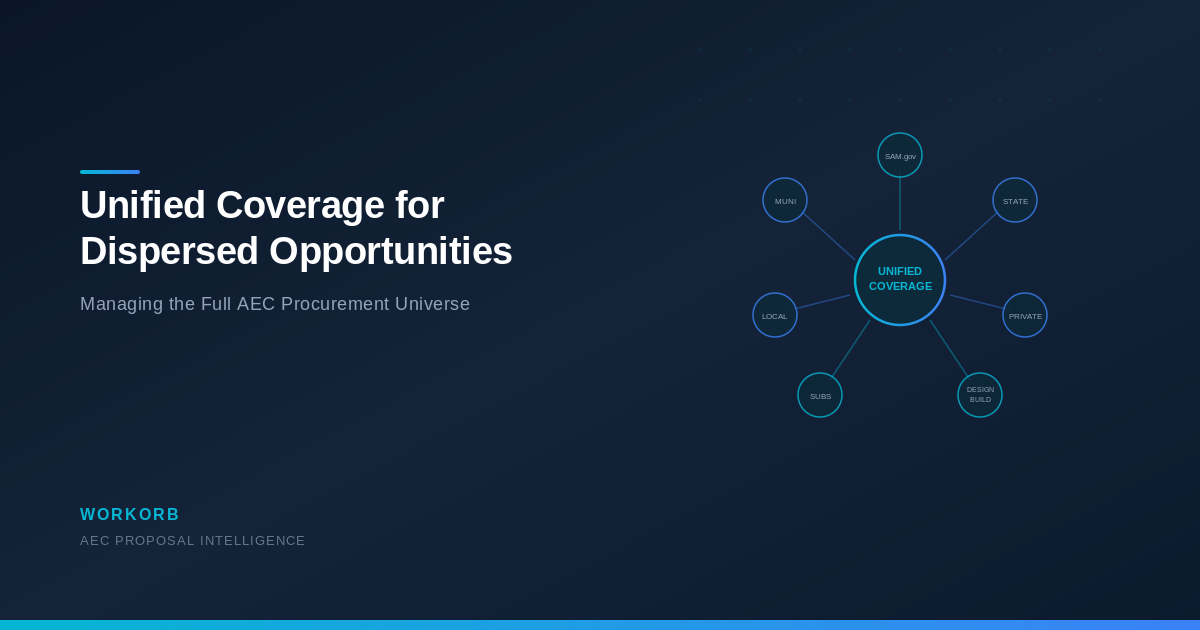
A 200-person architecture firm with expertise in transportation, water infrastructure, and K-12 schools theoretically has access to thousands of potential opportunities annually. Federal opportunities appear on SAM.gov. State DOT projects post on agency websites. Municipal procurement departments advertise through a patchwork of local portals. Private developers issue RFPs through consultants. Design-build entities seek teaming partners through industry networks. Subconsultants offer participation in primes' pursuits through direct outreach. Without systematic coverage, the firm sees a fraction of these opportunities. With systematic coverage—understanding where opportunities appear, automatically monitoring relevant sources, and intelligently filtering to surface actionable leads—the firm can maintain visibility of hundreds of potential pursuits and strategically select which ones to pursue.
This is the challenge and opportunity that defines AEC business development today. The procurement universe is fragmented. Unlike industries with centralized procurement (corporate IT, pharmaceuticals, etc.), AEC opportunities are dispersed across federal, state, and local government portals, private sector channels, design-build networks, and subconsultant partnerships. The firms that master unified coverage—that maintain systematic visibility of this dispersed opportunity landscape while intelligently prioritizing where to invest pursuit effort—will capture disproportionate market share. Here's how leading firms are solving this challenge.

How AEC firms monitor opportunities across government portals, state/municipal sites, private RFPs, and subconsultant networks to maximize coverage while prioritizing intelligently.
Government projects represent a substantial portion of most AEC firms' opportunity pipelines. The federal government's SAM.gov portal is the primary gateway for federal opportunities—design services for federal agencies, infrastructure grant-funded projects, defense construction work. State DOTs post projects through their respective procurement systems. Municipal governments advertise through a mixture of local procurement portals, private platforms like BidSync or Bonfire, and sometimes through engineering consultancy lists distributed to pre-qualified firms.
Systematic government coverage requires monitoring across all these channels simultaneously. A firm might set up SAM.gov searches for opportunities matching its disciplines and geographic focus (e.g., "architectural and engineering services for transportation, water, and education sectors in the Western U.S."). It monitors the state DOT sites in its key markets—setting up automated searches for bridge design, water infrastructure, highway projects. It monitors major municipal portals in target cities and regions. For a firm with national aspirations, this might mean monitoring dozens of information sources.
Without intelligent filtering, this creates information overload. A SAM.gov search for "engineering services" might return hundreds of results monthly—the vast majority irrelevant. A state DOT portal might list 50+ active projects at any time—many outside the firm's capability or geographic focus. Leading firms address this through intelligent monitoring systems that filter opportunities by project type, scope, likely team size, budget, and geography. Rather than manually reviewing hundreds of postings, pursuit teams see 10-15 truly relevant opportunities per month—opportunities where the firm has genuine competitive advantage or strategic interest.
The timing advantage is also significant. Many firms discover opportunities only when the RFP is officially released and the clock starts ticking toward the response deadline. Leading firms learn about opportunities earlier—sometimes weeks before RFP release—when opportunities are announced as "intent to solicit" or "pre-solicitation notice." This early warning allows time for pre-RFP research, client outreach, and relationship building. By the time the formal RFP arrives, the firm has already educated itself on the client's priorities, introduced itself to decision-makers, and thought strategically about positioning. All of this occurs before the 2-3 week RFP response period begins—providing substantial competitive advantage.
Beyond government procurement, significant opportunities exist in the private sector. Corporations planning facilities expansions, institutional organizations (hospitals, universities, foundations) undertaking major capital projects, developers managing mixed-use or master-planned communities—these entities issue RFPs for design and engineering services. They don't post on SAM.gov or state DOT sites. Instead, they work through retained consultants or issue RFPs through intermediaries.
Coverage of the private sector requires different channels. Professional networks and industry associations (AIA, ACEC, APWA) often distribute opportunity lists to members. Consultancy relationship networks—connections with program managers, owner's representatives, and developer contacts—generate project leads. Trade publications and industry news sources announce planned projects and related procurement. Some firms monitor local real estate news and development announcements to identify projects in early planning stages, then proactively approach project teams about design services.
For firms pursuing design-build work, another important opportunity source is design-build entities and contractors seeking consultants as team members. A prime contractor pursuing a major DOT design-build project might need specialist consultants (environmental engineers, utilities coordinators, landscape architects). Rather than automatically using incumbent partners, forward-thinking primes reach out to the market seeking qualified consultants. Firms that have made themselves visible in these networks—through professional participation, demonstrated expertise, and proactive relationship building—receive these inquiries directly.
Unified coverage means maintaining visibility across all these private sector channels. This might mean: subscribing to development announcement services that flag planned projects in target markets; maintaining active relationships with key consultancy partners and owner's representatives; monitoring trade publications and industry websites for announced projects; participating visibly in professional organizations where project teams gather; and being prepared to respond quickly when private sector RFPs arrive with shorter response timelines than typical government solicitations (often 1-2 weeks rather than 3-4 weeks).
Another critical but often underutilized opportunity source is the subconsultant network. Design-build teams, large A/E firms, and contractors pursuing opportunities often actively recruit specialized consultants. An environmental engineering firm pursuing a major infrastructure remediation project might seek geotechnical specialists and hydrogeological consultants. A transportation design-build team pursuing a complex urban project might seek specialty traffic engineers. A healthcare architecture firm pursuing a large hospital project might seek medical planning specialists and healthcare IT integrators.
For firms with specialized expertise, these teaming opportunities can represent substantial revenue—often with lower business development cost than pursuing opportunities as a prime. Rather than managing an entire pursuit and bearing all development risk, a specialty consultant joins a team with capacity to execute and established client relationships. The challenge is visibility: knowing what opportunities are being pursued and by whom, and being in the right network to receive teaming inquiries before opportunities pass by.
Systematic coverage of teaming opportunities requires being actively involved in relevant professional networks, maintaining relationships with design-build contractors and larger A/E firms who are likely to seek partners, and being visible as a specialist in your domain. An environmental specialist firm might maintain relationships with 20-30 larger A/E firms and contractors who regularly pursue infrastructure projects requiring environmental expertise. When one of these firms wins a pursuit that includes environmental scoping, the specialist is among the first contacted about teaming. A structural engineer specializing in bridge design might maintain relationships with state DOTs and major transportation consultants who regularly bid bridge projects and often need specialized structural input.
The most successful subconsultants don't wait passively for teaming inquiries. They actively track which entities are winning major pursuits (by monitoring public agency press releases and industry news), and they proactively reach out with expressions of interest in future work. They maintain consistent visibility in professional networks and industry events. They develop a reputation as responsive, capable partners who can mobilize quickly when needed. Over time, this builds a pipeline of teaming relationships that generates consistent opportunities without the full business development cost of pursuing as a prime.
Unified coverage of dispersed opportunities creates an abundance of potential leads. A firm systematically monitoring federal, state, and municipal procurement sources, plus private sector channels, plus teaming networks might become aware of 100-150 potential opportunities monthly. Pursuing all of them is impossible. Even pursuing 30-40 annually stretches most firm's resources. Smart firms implement intelligent filtering to surface opportunities meriting serious pursuit consideration.
Filtering criteria typically include: (1) Fit with firm capabilities. Does the project type match the firm's expertise? Are the required disciplines in-house or available through established subconsultants? Is the project size manageable? (2) Competitive position. Does the firm have genuinely relevant past experience the client is seeking? Can the firm field a competitive team? Are there likely competitors? (3) Strategic value. Does the project fit the firm's growth strategy? Is the client or sector a priority? Would winning this project strengthen the firm's position in a target market? (4) Probability of success. Given the firm's capabilities and likely competition, what's the realistic probability of winning? Is this a 20% probability opportunity or a 60% probability opportunity? (5) Resource availability. Does the firm have bandwidth to pursue this opportunity thoroughly? What's the cost of pursuit vs. potential revenue?
Intelligent filtering systems help with this analysis. They can flag opportunities that meet certain criteria (e.g., "educational facilities, $50M-150M budget, in the Northeast, with relevant past projects available") and score others based on competitive position and strategic fit. Rather than asking business development staff to manually evaluate 100+ opportunities monthly, the system surfaces 10-15 that merit serious consideration and provides scoring on the rest. This allows strategic focus on high-probability, high-value pursuits while maintaining visibility of other opportunities that might merit opportunistic pursuit.
Firms that master unified opportunity coverage gain substantial competitive advantages. First, they see more opportunities than competitors who rely on passive discovery. A firm that systematically monitors SAM.gov, state DOT sites, municipal portals, private sector channels, and teaming networks might have visibility of 2-3x more opportunities than a firm that primarily relies on client calls and relationships. Even if the win rate is identical, 2-3x more opportunities means 2-3x more wins.
Second, they see opportunities earlier. While many competitors discover RFPs only after official release, systematic monitor users learn about opportunities during pre-solicitation phases. This early visibility allows time for research, relationship building, and strategic positioning before the formal response period begins—creating advantage when the actual proposal effort starts.
Third, they make smarter decisions about where to invest. By filtering hundreds of potential opportunities against strategic criteria (fit, competitive position, strategic value, success probability), firms can focus pursuit resources on opportunities with highest return potential. A firm pursuing 30 opportunities might win 10-12 if it pursues them all reactively. The same firm might win 12-15 if it strategically pursues only the highest-probability 25-30 opportunities, investing more deeply in those where it has genuine advantage. The same resources, applied more strategically, generate higher returns.
Finally, they build deeper market knowledge. Consistent monitoring of procurement sources creates institutional awareness of where opportunities are, when they typically appear, who the decision-makers are, and what clients are prioritizing. A transportation engineering firm that has systematically monitored state DOT opportunities for three years understands the procurement calendar (which agencies solicit in which seasons), knows the key decision-makers at each DOT, understands each agency's evaluation priorities, and can position for opportunities proactively. Competitors who only pursue opportunities reactively never develop this depth of market knowledge.
For AEC firms serious about sustainable business development, unified opportunity coverage isn't a luxury. It's foundational. The firms that will dominate AEC procurement in the next 5-10 years will be those that treat opportunity identification as a systematic, continuously-monitored process rather than a reactive activity. They'll maintain visibility of hundreds of potential opportunities across government and private procurement channels. They'll filter intelligently to focus pursuit resources on high-probability opportunities. They'll respond quickly and strategically because they've already researched clients and positioned themselves ahead of formal RFP release. And they'll extract maximum value from their business development resources because every hour spent is focused on opportunities where success is achievable and strategic value is clear. This is how modern AEC firms win in dispersed, fragmented procurement environments.


