
A 150-person structural engineering firm receives notification of an RFP for a major bridge rehabilitation project through its SAM.gov monitoring system. The RFP is complex: 220 pages, includes a mandatory SF330 form, requires detailed cost proposals, specifies DBE participation goals of 15%, demands specific insurance and bonding requirements, and lists 12 evaluation criteria weighted across relevant experience, team capability, and cost.
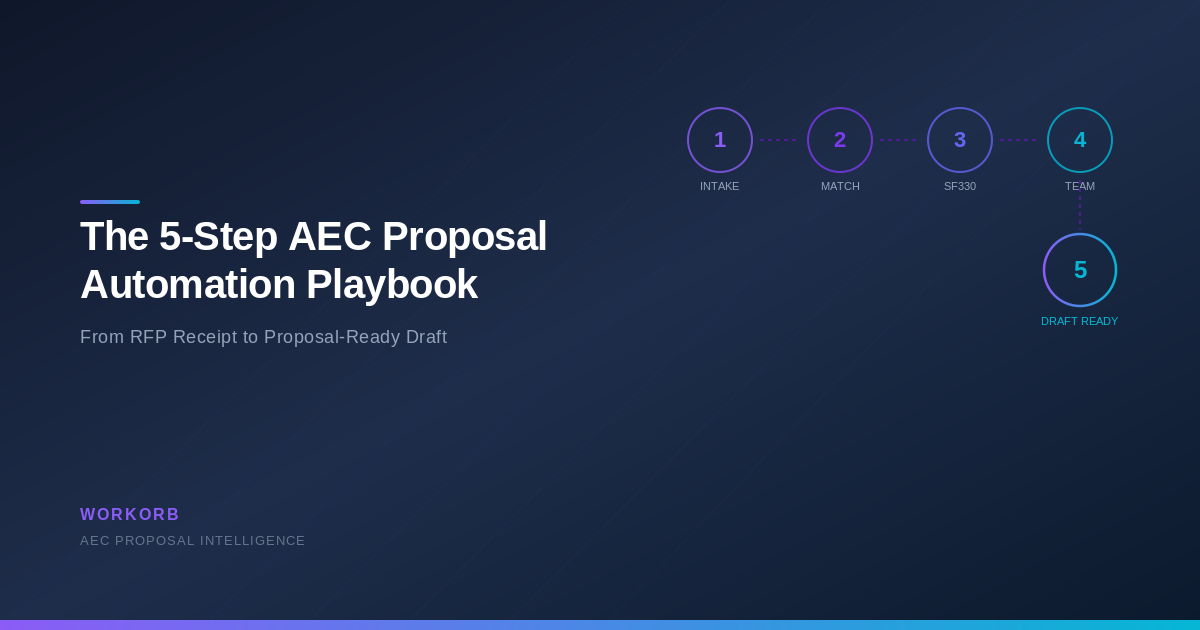
Historically, the firm’s response timeline would look like this: weeks of effort, numerous coordination touchpoints, and inevitable quality inconsistencies across sections. The most efficient AEC firms have systematized this process. They’ve built workflows that automatically populate standard proposal sections, intelligently match firm resources to RFP requirements, coordinate subconsultant contributions in parallel rather than sequence, and produce proposal-ready drafts in significantly less time. Here’s how leading firms have structured this automation.

A practical workflow for automating AEC proposal intake and production—from SF330 population to compliance matrices—that helps firms respond faster while maintaining quality control.
The automation sequence begins the moment an RFP arrives. Rather than treating the solicitation as a static document to be passively read and manually dissected, efficient AEC firms use intelligent document processing to automatically extract key information: deadline, client contact information, project scope summary, selection criteria and their relative weights, stated project budget and timeline, insurance and bonding requirements, DBE/diversity goals, prevailing wage applicability, and compliance obligations.
For firms pursuing federal opportunities, this extraction process identifies whether the project is subject to Davis-Bacon prevailing wage requirements, if it falls under Buy American provisions, or if specific environmental compliance frameworks apply. For state or municipal projects, the extraction flags whether the opportunity is a traditional design-bid-build or design-build pursuit, and whether CMAR language appears.
This intelligence extraction is where AI tools prove most valuable for AEC firms. A modern proposal automation platform can scan an RFP, identify selection criteria even when they’re buried in narrative form rather than listed as explicit bullet points, and flag content requiring manual review—unusual requirements, non-standard insurance specifications, or evaluation criteria the firm has weak historical examples for. Time saved: 6-8 hours per RFP.
Once RFP requirements are extracted, the automation system cross-references those requirements against the firm’s project database to identify relevant past experience. If the RFP emphasizes bridge rehabilitation experience, the system identifies all completed bridge projects. If it requires experience with progressive design-build, the system filters for projects matching those criteria.
Rather than asking proposal teams to manually compile project sheets, the automation system generates them from the firm’s standardized project database. Project sheets are populated with project name, scope summary, budget, schedule, key outcomes, client references, and relevant team members. They’re formatted consistently and automatically sorted to lead with the most relevant projects. Time saved: 4-6 hours per pursuit.
For subconsultant-heavy pursuits, this matching process becomes even more valuable. A design-build team pursuing a complex transportation project might involve 8-12 subconsultants. Rather than coordinating with each subconsultant to compile their project sheets, the design-build prime can search a shared project database or provide a template that automatically populates from the prime’s understanding of each subconsultant’s experience.
For AEC firms pursuing federal and many state/local projects, the Standard Form SF330 is non-negotiable. The form’s sections on organizational experience, past performance, key personnel, and technical approach must be completed with precision and consistency.
Modern automation platforms integrate directly with AEC firm management systems to automatically populate SF330 sections. Key personnel information pulls directly from the firm’s personnel database—ensuring resumes are current, credentials are accurately represented, and role descriptions align with SF330 requirements. Organizational experience data pulls from the firm’s project database, capturing relevant information like number of projects in the past ten years and total volume of work in the category.
Similarly, compliance matrices can be automated. If a client specifies weighted evaluation criteria like: relevant experience (35%), key personnel (25%), technical approach (20%), cost (15%), and schedule (5%), the automation system generates a compliance matrix cross-referencing firm credentials against each criterion. Time saved: 8-10 hours per proposal for SF330 and compliance matrix population.
AEC proposal success depends on fielding the right team against stated evaluation criteria. Key personnel requirements appear in virtually every RFP: the client specifies minimum years of experience, relevant project history, specific professional licenses (PE, AIA, PLS), and sometimes specific technical expertise.
Automation streamlines this process significantly. The system identifies team requirements from the RFP and queries the firm’s personnel database to identify candidates matching these criteria, ranking them by relevance and availability. For multi-discipline firms, the system can identify whether internal candidates meet requirements or if subconsultant partners must be engaged.
For firms with established subconsultant networks, the automation system can simultaneously request information from multiple partners—providing a standardized template and a deadline. As responses arrive, the system integrates them into the proposal. For a complex pursuit involving 10 subconsultants, this parallel coordination can compress a two-week sequential process into five days. Time saved: 10-12 hours per proposal for team assembly and resume formatting.
Once requirements are extracted, relevant experience is matched, SF330 sections are populated, and team members are assembled, the final step is proposal-ready draft generation. Systems that understand AEC proposal conventions can generate draft technical approach narratives informed by project requirements, suggested team compositions, and firm historical precedent. These AI-generated drafts require expert refinement, but the pursuit team starts with a structured draft addressing all evaluation criteria rather than a blank page.
The proposal-ready draft also includes a quality control checklist: Are all required exhibits included? Are resumes current? Does the compliance matrix address all stated criteria? Are insurance requirements met? Does the proposal comply with client formatting specifications? Are past performance narratives specifically aligned to the current client’s priorities?
For an architecture or engineering firm pursuing 20-30 opportunities annually, this five-step automation workflow compounds dramatically. Each RFP that would historically require 2-3 weeks now requires 4-6 days. The quality improves because every section is generated against clear, extracted requirements. Team assembly is faster because available talent is systematically matched to stated needs. And the firm can pursue more opportunities because the time cost of each pursuit has dropped. Automation creates a virtuous cycle where proposal quality improves while cycle time drops.


