
A structural engineering firm with 180 people pursues 25-30 opportunities annually across municipal bridge projects, state DOT infrastructure work, and federal transportation grants. Five years ago, the firm's business development team manually monitored opportunities, tracked RFP deadlines in spreadsheets, compiled proposals reactively over 3-4 weeks per pursuit, and had limited visibility into why some proposals won while others lost. Today, the same firm proactively monitors 100+ potential opportunities through integrated SAM.gov and state procurement feeds, responds to qualified pursuits with proposal-ready drafts in 5-7 days, and has documented institutional knowledge of how their proposals perform against different client preferences and evaluation criteria. The difference isn't just efficiency—it's systematic competitive advantage.
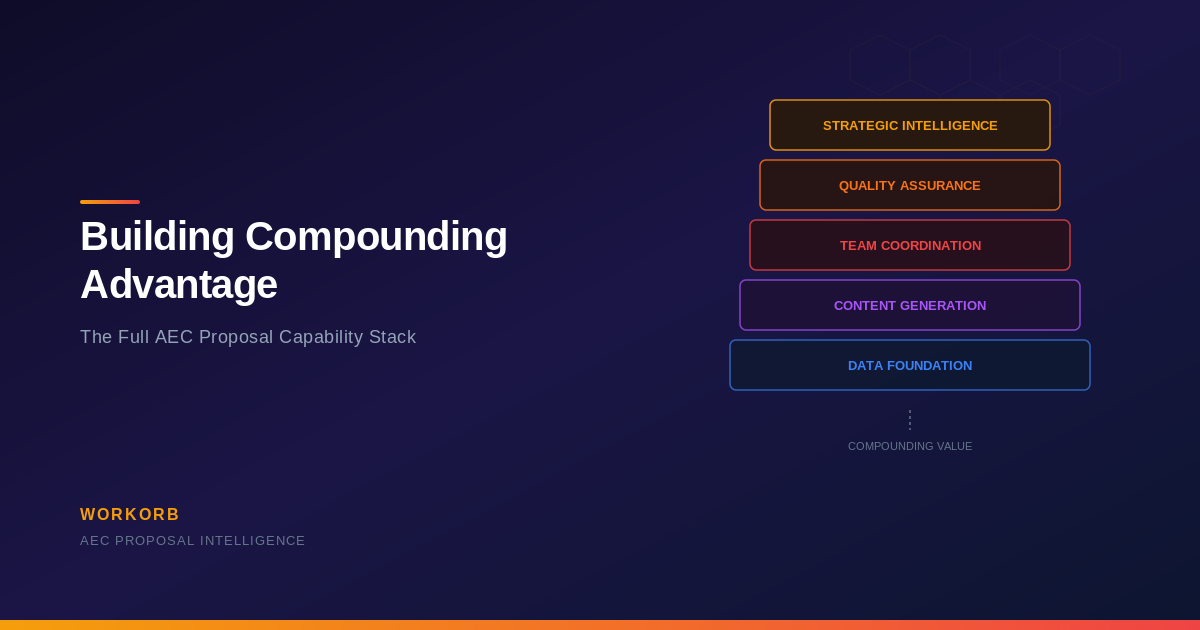
This transformation represents the full realization of what we call the AEC proposal capability stack. Unlike point solutions that optimize individual proposal tasks, the capability stack integrates opportunity identification, requirement analysis, content generation, and outcome learning into a compounding system where each element makes the others more effective. Understanding how this works—and how to build it—is essential for AEC firms serious about competing at the highest levels.

How the complete AEC proposal capability—from opportunity intake to win/loss learning—creates compounding competitive advantage across municipal, state, and federal pursuits.
The stack begins with opportunity identification. Rather than relying on business development staff to manually search federal opportunity portals, state DOT websites, and municipal procurement announcements, leading AEC firms implement automated monitoring systems that continuously scan these sources and surface relevant opportunities. The system understands AEC project types and firm capabilities well enough to distinguish genuine opportunities from irrelevant noise.
For a multi-discipline AEC firm, this is critical. A firm with transportation, buildings, water, and environmental expertise receives hundreds of potential opportunities monthly across these sectors. Manual review of every posting would consume enormous time. Intelligent monitoring filters opportunities by discipline (is this a transportation or buildings project?), client type (federal, state, or municipal?), likely team size and complexity, estimated budget, and geographic location. Business development staff see a prioritized list of 5-10 opportunities per week that genuinely fit firm capabilities and strategic priorities, rather than hundreds of generic postings.
The system also flags timing and logistics. When a monitored opportunity officially posts, the system alerts relevant staff with deadline information, client contact details, and preliminary scope summary. As the RFP is released and documents become available, the system flags this as well. For opportunities where the firm decides to pursue, this baseline information is automatically loaded into the proposal management system, eliminating the first 1-2 days of manual research and data entry. For a firm pursuing 25+ opportunities annually, this automation recaptures 50-100 hours of business development time—time better spent on pursuit strategy and client relationship building.
Once an RFP is selected for pursuit, the second layer of the capability stack engages: intelligent requirement extraction and opportunity assessment. Rather than waiting for a proposal manager to manually read through a 150+ page RFP to understand client priorities, the system performs this analysis automatically.
The system identifies: What does the client care most about? (weighted evaluation criteria) What experience do they value? (relevant project types, industries, client sectors) What team capabilities are they seeking? (disciplines, certifications, experience levels) What are the compliance and contractual requirements? (prevailing wage, bonding, insurance, DBE goals) What are the schedule and delivery expectations? (design-bid-build vs. design-build vs. CMAR, key milestones, timeline) What are potential risks or complications? (unusual requirements, non-standard evaluation approaches, tight schedules)
This requirement analysis then informs strategic pursuit decisions. Are our relevant projects truly relevant to this client's criteria? Do we have the team capability they're seeking? Are there gaps we'd need to address through subconsultants? Given our competitive position and the likely competition, what's our realistic win probability? Is this a pursuit we should commit to fully, or should we pursue more lightly?
For a 180-person firm with 25-30 active pursuits, this analytical layer prevents wasted effort on low-probability opportunities and ensures that when the firm commits to a pursuit, it does so with clear understanding of what success requires. A pursuit manager reviewing an automatically-generated requirement analysis might immediately recognize that the client is heavily weighting relevant healthcare facility experience, that the firm has strong credentials in this area, and that this is a high-priority pursue. Or it might reveal that the client is seeking specific environmental remediation expertise the firm lacks, suggesting either a lower-priority pursue or a subconsultant partnership. Either way, the strategic decision is informed by clear requirement analysis rather than guesswork.
The third layer—where the capability stack creates genuine differentiation—is content generation and asset reuse. This is where past wins compound. As the firm completes successful projects documented in its proposal database, and as proposals submitted across multiple pursuits are indexed by content type, winning approach, and client response, the firm's institutional knowledge becomes increasingly valuable.
When a new opportunity arrives with evaluation criteria similar to a previous winning proposal, the system surfaces that previous content as a starting point. When a new pursuit requires demonstrating healthcare facility experience and the firm has 12 completed healthcare projects in its database, the system identifies which 3-4 are most relevant to this particular client's criteria. When team assembly requires specific expertise, the system knows which team member combinations have worked successfully together on previous projects. When technical approach requires explaining design-build delivery methodology, the system accesses successful technical approach narratives from previous design-build pursuits.
This is fundamentally different from how most AEC firms operate. Most firms start each proposal from rough templates and rebuild content from scratch. The most efficient firms recognize that they've already solved many of these problems before. A technical approach to D-B-B delivery for a transportation project shares structure and strategy across multiple pursuits. A past performance narrative about complex stakeholder coordination on a municipal project provides a template applicable to multiple future clients. A team member's resume describing relevant experience on school projects is valuable currency across multiple school project pursuits. The capability stack surfaces these assets and applies them efficiently across new pursuits.
The system also learns from experience. When a proposal narrative on a particular topic generated significant client interest (evidenced by pre-proposal questions or post-award feedback), that narrative is flagged as high-value content and prioritized for similar future opportunities. When a particular team composition successfully delivered a complex project, that combination is preserved as a reference for future team assembly. Over time, the firm's proposal content—its articulation of relevant experience, its descriptions of technical approach, its past performance narratives—becomes refined and optimized based on market feedback.
The fourth layer is integrated proposal production. By this point in the capability stack, the infrastructure for efficient proposal development is in place: requirements are extracted, relevant content is identified, project examples are selected, team members are assembled. The proposal production layer orchestrates all this into a coherent, governance-compliant document.
Rather than sequential proposal development (weeks spent on one section, then another, then compilation), integrated production happens in parallel. SF330 sections populate simultaneously from personnel and project databases. Technical approach narratives are drafted based on requirement analysis. Compliance matrices are generated from project history. Project sheets are assembled from selected past projects. Team rosters are compiled from identified team members. Instead of a waterfall process spanning 3-4 weeks, all major sections are in draft form within 3-4 days, ready for subject matter expert review and refinement.
Governance controls ensure quality and accuracy. Every narrative is checked against requirements to verify alignment. Every claimed credential is verified against personnel records. Every past performance statement is verified against project documentation. Every team member's qualifications are confirmed to meet stated requirements. A compliance checklist ensures nothing is missed: required exhibits are included, formatting meets client specifications, all evaluation criteria are addressed, all team members' resumes are current, all insurance and bonding requirements are documented.
By Layer 4, the proposal that emerges isn't just faster—it's smarter. It directly addresses what the client's evaluation criteria emphasize. It showcases the firm's most relevant experience. It proposes the best-qualified team. It articulates approach in language informed by client preferences and previous successful proposals. The quality is higher because less is left to chance or guesswork.
The final layer—and the one that creates compounding advantage—is systematic win/loss learning. When proposals are submitted, the firm tracks outcomes. Wins are analyzed: Which past performance examples were most persuasive? How did the client respond to our technical approach? Were there particular team members or qualifications that stood out? Which narrative themes resonated most? Losses are analyzed similarly: Where were we weak in the client's evaluation? Did they prefer a different technical approach? Did a competitor offer relevant experience we couldn't match? What would have strengthened our position?
This feedback feeds back into the capability stack. A past performance narrative that consistently resonates with clients of a particular type gets prioritized for similar future pursuits. A technical approach that won on multiple occasions gets refined and reused. Team member combinations that delivered successfully become reference points for future team assembly. Narrative themes that clients respond to enthusiastically get woven into organizational positioning. Conversely, approaches that repeatedly lose get deprioritized or retired.
For a firm pursuing 25+ opportunities annually, this creates a virtuous cycle. Year 1: the firm pursues opportunities with moderate efficiency and develops institutional knowledge about what works. Year 2: that institutional knowledge is applied to improve proposal quality and cycle time. More pursuits can be pursued because each takes less time. Proposal quality improves because past learning is applied. Win rate improves because proposals better reflect what clients value. Year 3: Higher win rates mean more successful projects in the firm's database, providing richer content for future proposals. More references and case studies are available. Team members accumulate more relevant experience. The entire capability stack becomes more valuable. Year 4 and beyond: the firm's competitive advantage compounds. The firm can pursue more opportunities faster, with higher quality, with better subject matter understanding—all because five years of proposal outcomes have informed and continuously refined the capability stack.
This is what separates the most effective AEC firms from the rest. It's not that they have smarter people—many firms do. It's that they've systematized proposal management into a capability stack where opportunity identification feeds strategic pursuit decisions, requirement analysis informs content strategy, past content is intelligently reused, production is orchestrated efficiently, and outcomes continuously refine the entire system. The stack creates compounding advantage: each successful proposal makes the next proposal better, and the system as a whole becomes more effective over time. For AEC firms serious about sustainable competitive advantage in proposal-driven markets, building this stack isn't optional. It's strategic imperative.


