
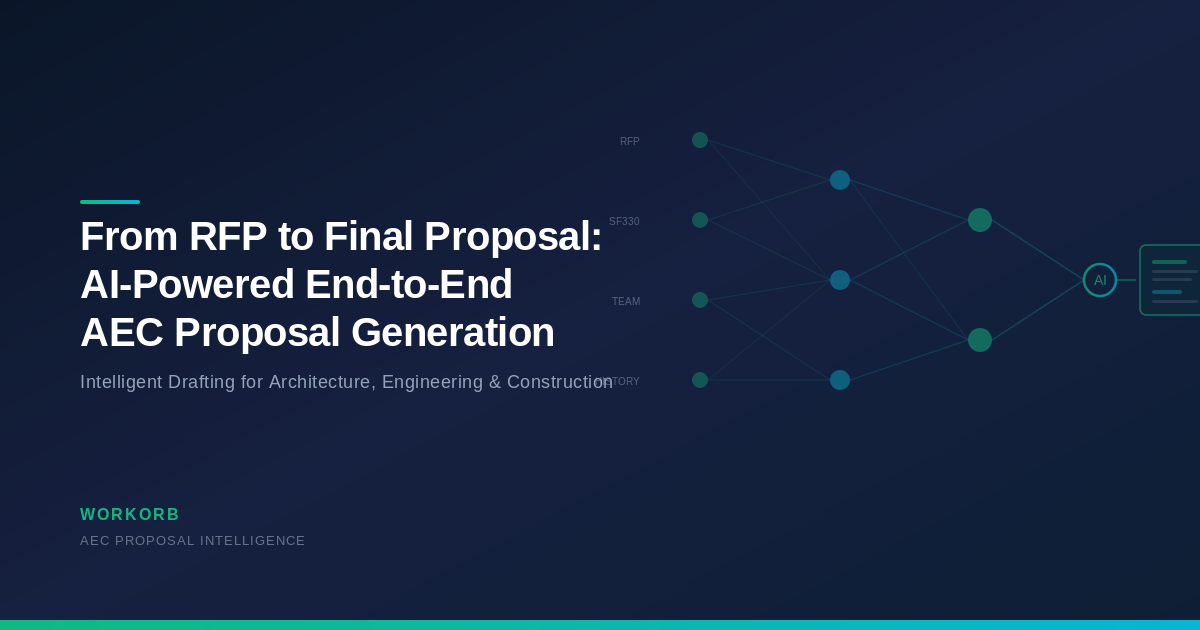
A 250-person architecture and engineering firm completes a municipal RFP for a $85 million water treatment facility expansion. The RFP arrives with 165 pages of requirements, detailed selection criteria emphasizing relevant water infrastructure experience and team capability, and a tight two-week response deadline. Rather than the traditional weeks-long proposal cycle, the firm responds with a comprehensive, high-quality proposal in nine days. The technical approach narratives are generated with full knowledge of evaluation criteria. The SF330 form is automatically populated from the firm's personnel and project databases. The past performance section surfaces the firm's three most relevant completed water treatment projects. Team members are intelligently assembled based on stated requirements. The entire proposal is generated, reviewed, refined, and submitted.
This isn't science fiction for AEC firms anymore. It's increasingly the operating reality for firms that have implemented modern, AI-augmented proposal generation platforms. But how does this magic actually work? How does intelligent automation transform a complex RFP into a finished, governance-approved proposal in days rather than weeks?

How AI generates AEC proposals from RFP requirements—automatically populating SF330 sections, assembling teams, matching past projects, and producing governance-controlled content.
The process begins with intelligent requirement extraction. When an RFP is uploaded, AI systems analyze the document to identify evaluation criteria, stated priorities, scope requirements, team member requirements, compliance obligations, and delivery expectations. This isn't simple text search. Modern AI understands that a requirement for "demonstrated experience with complex stakeholder coordination" might appear as narrative prose rather than a bulleted requirement. It recognizes that DBE participation goals might be embedded in contract terms rather than listed as explicit criteria. It identifies cross-references where requirements are stated in one section and elaborated in appendices.
For an AEC firm pursuing a design-build school project, the system extracts that evaluation will weight: (1) relevant K-12 experience at 30%, (2) school operations/phasing complexity at 20%, (3) sustainability features and LEED performance at 25%, (4) technical approach to design-build delivery at 15%, and (5) cost at 10%. It identifies that the client specifically values projects with community engagement components. It notes that the RFP requires all key personnel to hold valid PE licenses. It flags that prevailing wage and DBE participation are contractual requirements.
From these extracted requirements, the AI system constructs a proposal content architecture—a structured outline of how the proposal should be organized to directly address all evaluation criteria. This content architecture becomes the blueprint for proposal generation. It specifies which sections must address relevant experience, which sections must highlight key team members and their qualifications, which sections must describe the technical approach to school phasing and operations, and which sections must articulate the firm's sustainability philosophy and expected LEED certification pathway.
Once content architecture is established, the system searches the firm's project database to identify past experience relevant to stated requirements. For the school project example, the system queries: "Show me all completed K-12 school projects with community stakeholder coordination, particularly those achieving LEED certification." The system ranks results by relevance—weighting project type, size, scope complexity, and outcomes against RFP criteria. It surface the firm's most persuasive historical examples: three completed schools ranging from $25-65 million, all achieving LEED Gold or Platinum, all delivered via design-build, all involving significant community input and phasing complexity.
Here's where AI proposal generation creates genuine value. Rather than asking proposal writers to manually construct past performance narratives for these projects, the system generates draft narratives automatically—pulling project details from the database and synthesizing them into persuasive prose that directly addresses the client's evaluation criteria. The draft narrative for the first school project might read: "Our recent delivery of Lincoln High School, a $52M new K-12 facility in [location], demonstrates our proven capability in complex stakeholder coordination. The project involved a phased design-build delivery across three school years, requiring continuous coordination with district administrators, parent groups, student councils, and community organizations. The final facility achieved LEED Platinum certification, exceeded district sustainability targets, and delivered within budget and schedule. Project Principal [Name], PE, led stakeholder engagement throughout design and construction, and [Name], AIA, served as lead architect."
These AI-generated narratives aren't polished prose waiting for publication. They're draft content that proposal managers review, refine, and polish. A pursuit manager might strengthen the language, add specific metrics, or emphasize particular aspects most relevant to the current client's priorities. But the narrative is already structured, factually grounded, and aligned to evaluation criteria. Rather than writing from scratch, the team is editing strategically—adding specificity, emphasizing differentiation, and ensuring authentic voice. This significantly accelerates narrative development.
For federal and federal-funded projects, the SF330 form is mandatory. The form requires detailed information on organizational experience, past performance, key personnel qualifications, and technical approach. Historically, completing SF330 sections meant manually transcribing data from multiple internal systems into the form's rigid structure.
Intelligent AEC proposal systems integrate directly with firm management systems to automatically populate SF330 sections. The system pulls organizational information from the firm's project database—calculating total volume of relevant project experience, number of personnel in each discipline, and past performance data across selected projects. It populates key personnel sections by searching the personnel database, automatically pulling resumes, credentials, and relevant project experience for each proposed team member. It verifies that proposed team members meet stated requirements (e.g., PE licenses, specific years of experience, relevant project history).
The technical approach section—the most critical element for demonstrating how the firm will successfully execute the project—can be automatically populated with framework content, then refined by technical experts. A system might generate: "Our technical approach to water treatment facility expansion leverages our [X] years of experience with similar expansion and upgrade projects. We will employ a phased construction methodology to minimize disruption to existing facility operations, employing [specific techniques]. Our team brings [specific expertise], ensuring continuity of water service throughout design and construction. Quality assurance includes [specific protocols]. Schedule management will employ [specific tools/methods]." Technical subject matter experts then refine this framework with specific details about how *their* firm will execute the project.
The system also automatically generates compliance matrices—cross-referencing firm qualifications and project experience against all stated evaluation criteria. Rather than manually checking off capabilities, the system searches project history and team credentials to provide evidence supporting each criterion. A compliance matrix might show: "Relevant K-12 Experience: 15 completed projects in past 10 years, 13 achieving LEED certification, all delivered on schedule and budget." Again, this is generated first and reviewed/refined second—a significant acceleration from the traditional approach of building the matrix from scratch.
Every AEC proposal's credibility rests on proposing the right team. When clients evaluate key personnel qualifications, they're assessing whether the proposed individuals can actually execute the project successfully. Team assembly therefore requires careful matching of role requirements against available talent and experience.
AI proposal systems assist by automatically identifying team requirements from the RFP and matching them against personnel databases. If the RFP specifies a Project Manager with 15+ years of transportation design-build experience and a valid PE license, the system queries the database for candidates matching these criteria. If multiple candidates are qualified, the system might rank them by relevance—weighting their specific experience on similar-sized projects and their availability during the project's likely duration. For Architects, Engineers, Specialists, and other roles, the system similarly identifies candidates and proposes team structures.
For design-build and other multi-disciplinary pursuits, team assembly becomes more complex because it must span multiple firms. A prime contractor might need to coordinate team member selections with subconsultant partners. Intelligent systems facilitate this by creating subconsultant request templates specifying needed roles and qualifications, distributing requests to multiple partners in parallel, and integrating responses as they arrive. Rather than a sequential process where the prime requests information from Consultant A, waits for response, then requests from Consultant B, the system collects information from all consultants simultaneously.
The system can also flag potential concerns. If the proposed Project Manager's last transportation project was three years ago, the system flags this for the pursuit manager. If the proposed design team lacks a LEED AP credential and the RFP emphasizes sustainability, this gets flagged. If a subconsultant is proposed for a role outside their typical expertise, the system identifies this for consideration. These flags help pursue managers build stronger teams and avoid proposing team members who might create credibility concerns.
AI-generated proposal content is powerful but requires governance. A proposal system that generates technical narratives, team descriptions, and compliance statements must ensure those statements accurately represent firm capabilities and don't overstate qualifications or make claims that can't be supported.
Intelligent AEC proposal platforms implement governance controls at multiple levels. Technical content generated by AI is automatically checked against firm policy and standards. If a narrative claims a team member will lead stakeholder engagement, the system verifies that person actually has relevant experience. If a technical approach describes a specific methodology, the system flags this for technical review to ensure the description accurately represents how the firm would execute the work. If past performance narratives claim specific outcomes (LEED certification, schedule performance, cost savings), the system verifies these claims against project records.
Proposal managers and subject matter experts maintain editorial control. AI-generated content passes through human review before being finalized. A technical team lead reviews technical approach narratives to ensure they're not just accurate but strategically positioned for the specific client and opportunity. A business development manager reviews past performance narratives to ensure they're genuinely relevant and persuasively articulated. A compliance officer reviews all statements to ensure they meet firm standards and client requirements.
This human-in-the-loop governance model is what makes AI proposal generation effective for AEC firms. The AI handles the heavy lifting—extracting requirements, generating structured content, assembling projects and personnel, populating forms, creating compliance matrices. Humans handle the refinement—ensuring accuracy, sharpening strategy, polishing prose, and making final judgment calls about what the firm should claim and how to position capabilities.
For AEC firms serious about proposal excellence, this represents the future of proposal development. RFPs arrive and are immediately analyzed for requirements and opportunities. Relevant past experience is automatically surfaced. Team capability is intelligently assessed. Proposals are generated in days rather than weeks, with all sections directly addressing evaluation criteria. Quality improves because every element is generated with clear knowledge of what clients are evaluating. Cycle time improves because proposal development moves from sequential (write narratives, then populate forms, then compile past performance) to parallel (all sections generated simultaneously, then refined). The firms that master this—that combine AI's capability to systematically process requirements and generate content with human expertise to ensure accuracy and polish—will compete at a entirely different level in AEC procurement.


