
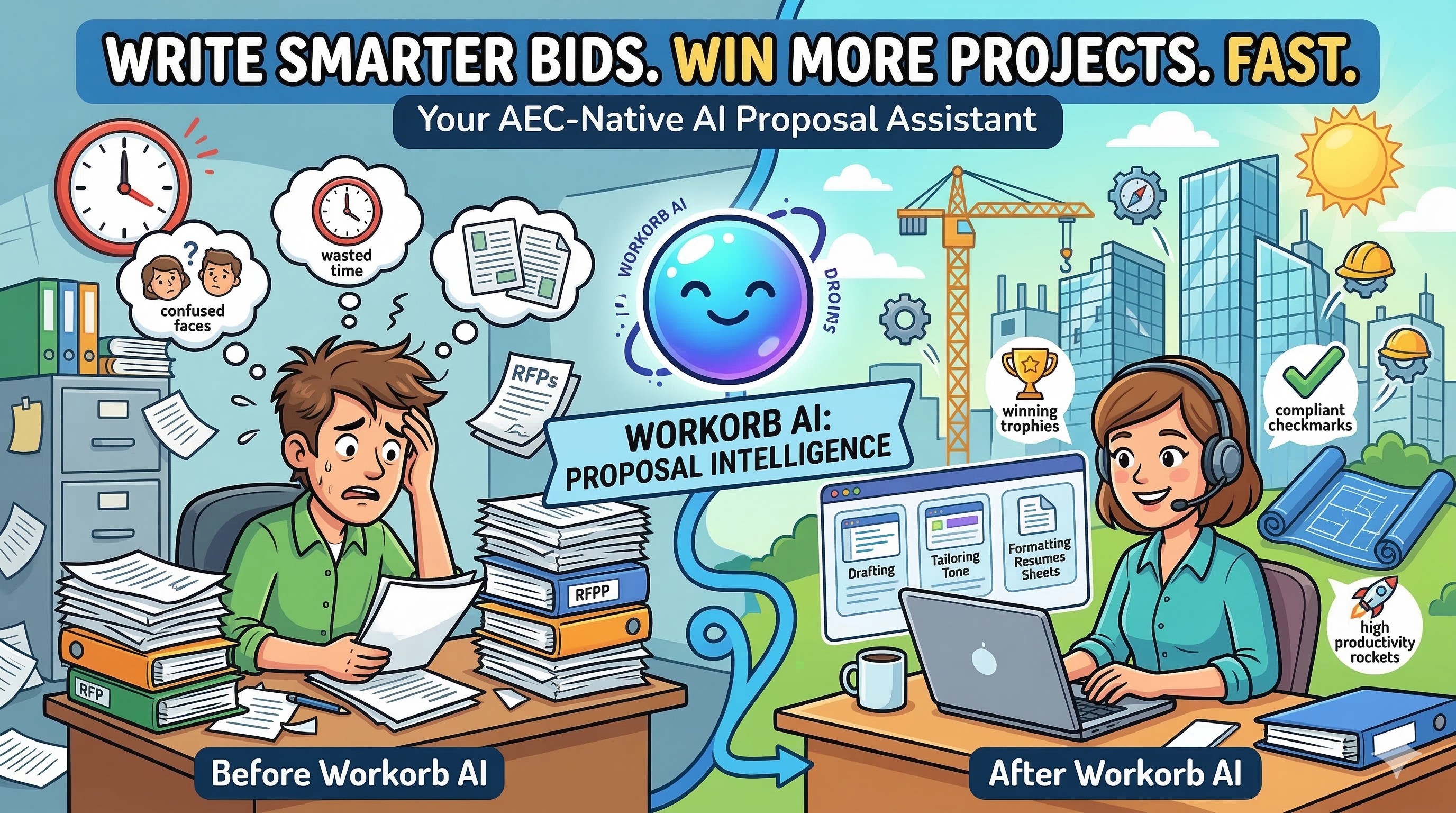
In the world of professional services—whether you’re in AEC, consulting, or manufacturing—the RFP remains the cornerstone of business development. Yet, for most marketing and technical teams, responding to RFPs is a source of intense friction. It’s a repetitive, high-stress cycle of shredding PDFs, chasing SMEs for content, and frantically reformatting Word documents at 11:00 PM.
Enter the promise of Artificial Intelligence.
The market is currently flooded with "AI solutions," but for proposal managers, the noise is deafening. Generic AI tools that simply "write text" are not just useless; they are dangerous. They hallucinate facts, erode your unique firm voice, and ignore strict compliance requirements.
To streamline your proposal operation and increase your win rate, you don’t need generic AI. You need Proposal-Centric AI.
At Workorb, we’ve cut through the noise to develop a unified platform that focuses solely on the AI capabilities that actually matter to proposal writing.
Here are the four pillars of intelligence required to transform your bidding process, and how Workorb encompasses them all.

1. Deep Context: Retrieval-Augmented Generation (RAG)
Generative AI (creating text) is exciting, but for a proposal, Retrieval (finding the right text) is far more important.
A generic AI model doesn’t know about your firm's unique 2023 infrastructure project in Seattle, nor does it know your specific safety protocols.
The Capability that Matters: The AI must first search your firm’s verified past proposals, project sheets, and SME resumes, and then use that specific data to generate an answer. This framework is called RAG (Retrieval-Augmented Generation). It ensures that drafts are grounded in reality, not hallucinated from the internet.
How Workorb Encompasses It: The moment you upload your Knowledge Hub (past proposals, boilerplate, resumes), Workorb builds a semantic map of your company expertise. When you generate a response to an RFP requirement, Workorb doesn’t create from scratch; it retrieves the most relevant past answers and synthesizes them into a fresh response for the new opportunity.
2. Structural Intelligence: RFP "Shredding" and Mapping
Writing a great answer is useless if it’s an answer to the wrong question. Proposal teams spend days manually analyzing RFPs just to create a compliance matrix.
The Capability that Matters: AI that can ingest a 100-page complex PDF (RFP), instantly "shred" it into individual requirements, understand the relationships between sections (e.g., Section L requirements mapped to Section M evaluation criteria), and automatically structure your document shell.
How Workorb Encompasses It: Workorb’s document parsing agents analyze the incoming RFP within minutes. It extracts requirements, deadlines, and mandatory formatting rules. It pre-builds your outline, ensuring that your final output is structurally compliant before a single word of content is drafted.
3. Stylistic Fidelity: Tailoring, Tone, and Branding
Every AEC or professional services firm has a distinct brand voice. Your proposals should not sound like a generic robot. Furthermore, a proposal must be tailored to the client.
The Capability that Matters: The AI must have the agility to instantly adapt a narrative. It should be able to take technical boilerplate and "tailor it for a municipal client focused on sustainability," while simultaneously maintaining your firm's specific brand tones (e.g., authoritative, innovative, partner-focused).
How Workorb Encompasses It: Workorb includes a full range of tone and tailoring controls. Before generating a section, you define the desired persona, tone, and audience. Our engine doesn’t just apply a global rule; it intelligently adjusts the sentence structure and vocabulary of the retrieved content to match your style guidelines.
4. Operational Velocity: Prompt Libraries and In-Line Editing
The biggest hurdle with AI isn’t the technology; it’s the user experience. Proposal writers shouldn't have to become "prompt engineers." They need actionable shortcuts integrated directly into their writing workflow.
The Capability that Matters: An integrated library of pre-built, optimized prompts designed specifically for the unique stages of proposal writing (e.g., "Summarize this project sheet," "Rewrite this section for conciseness," "Adapt this bio for a PM role").
How Workorb Encompasses It: Workorb’s editor isn’t a blank chat window. It’s a structured environment featuring a powerful, proposal-specific Prompts Library. With one click, writers can refine their existing text or generate new content, with all the formatting (like bulleted lists and technical specifications) preserved.
The Workorb Difference: Unity
Many firms are attempting to solve this with disjointed solutions—using one tool for search, ChatGPT for writing, and InDesign for formatting. This approach fails because the data is fragmented.
Workorb is a unified platform. Our AI understands the RFP structure, the context of your firm’s history, and the formatting constraints of your final template, all simultaneously.
When you bring these specific capabilities together, you don’t just write proposals faster; you write higher-quality bids that are tailored, compliant, and branded to win.


