
A bid team submits a 200-page proposal for a major government contract. The executive summary promises 'industry-leading innovation.' Section 4 describes the approach as 'proven and conservative.' Section 7 references a case study with outdated metrics. The formatting changes noticeably between sections because three different people wrote them in three different templates.
The evaluators notice. They always notice.
Inconsistency in RFP responses isn't just an aesthetic problem. It signals organizational dysfunction to evaluators. If a company can't coordinate a coherent proposal, what does that suggest about how they'll manage the actual project? Research consistently shows that evaluators use proposal quality as a proxy for execution quality. Formatting inconsistencies, contradictory messaging, and unstructured outputs erode confidence—even when the underlying technical solution is strong.
The fix isn't more editing passes. It's structural: building systems that produce consistent outputs by default rather than relying on individual diligence to catch inconsistencies after the fact.

Inconsistent formatting, mismatched messaging, and ad-hoc templates cost bid teams deals they should win. Here's a playbook for structured, auditable proposal outputs.
The shift from inconsistent to consistent proposals requires three structural changes.
Standardized requirement extraction. When every RFP is processed through the same extraction framework, requirements are captured in consistent formats regardless of how the client structures their solicitation. A 50-page RFP and a 500-page RFP both produce the same structured output: requirements matrix, evaluation criteria with weights, compliance checklist, and deadline timeline. This consistency at the front end cascades through the entire response.
Template-driven response generation. Rather than starting each section from a blank document, responses are generated against standardized templates that enforce consistent formatting, tone, and structure. Headers match. Callout styles match. The executive summary uses the same voice as the technical approach. When AI generates first drafts against these templates, the consistency is built in—not bolted on during review.
Traceable compliance matrices. Every claim in the proposal maps back to a specific requirement in the RFP. Every requirement in the RFP maps to a specific section of the response. This traceability isn't just good practice—it's an auditable artifact that evaluators can follow. When a reviewer checks whether you've addressed Criterion 3.2, they can trace directly from your compliance matrix to the relevant proposal section.
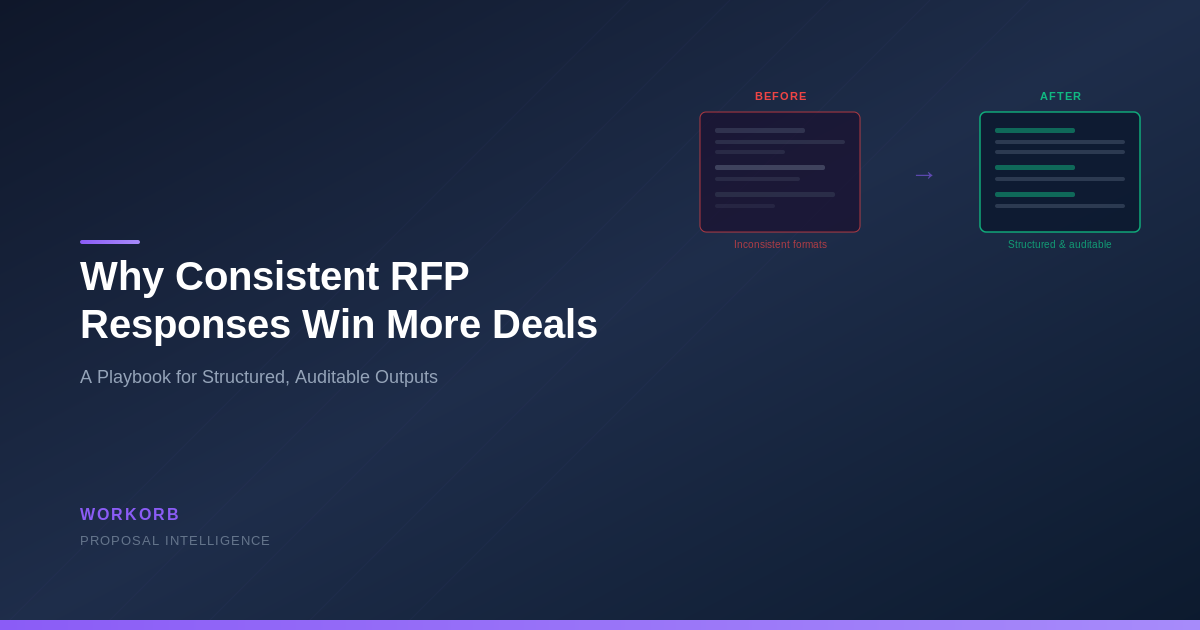
Before: Each proposal manager builds their own compliance tracker in Excel. Some track requirements by page number, others by section header, others by keyword. When a teammate inherits a pursuit mid-cycle, they spend hours understanding the previous manager's tracking system before they can contribute. Formatting varies across sections because different writers use different Word templates. Final reviews catch 60-70% of inconsistencies, but the rest ship to the client.
After: The system extracts requirements into a standardized matrix automatically. Compliance tracking uses the same structure for every pursuit. Response sections generate from approved templates with consistent formatting. Every team member sees the same view of requirements, compliance status, and section ownership. Final reviews focus on content quality and strategic positioning rather than formatting cleanup. Inconsistencies drop below 5%.
Workorb achieves this by treating consistency as a system property rather than an individual responsibility. Requirements extraction, template management, compliance tracking, and response formatting all run through the same structured pipeline. The result isn't just prettier proposals—it's faster review cycles, fewer rework loops, and higher evaluator confidence. When your outputs are structured, traceable, and consistent, evaluators spend their time evaluating your solution instead of deciphering your document.


