
An AEC firm responding to a federal SF330 has almost nothing in common with a SaaS company answering a security questionnaire. A healthcare provider bidding on a managed services contract uses completely different terminology, compliance frameworks, and evaluation criteria than a defense contractor pursuing a CPFF engagement. Yet most AI RFP tools treat these as the same problem: ingest document, extract questions, generate answers.
The result is predictable. AI-generated responses that sound plausible but miss industry conventions. Technical language that's slightly off. Compliance frameworks that don't match the regulatory environment. Templates that force content into structures that don't align with how evaluators in that industry actually read proposals.
Customization isn't a feature—it's the difference between AI that helps and AI that creates more editing work than it saves. The question is how deep the customization goes.

Generic RFP tools treat every bid the same. Here's how configurable templates, adjustable drafting styles, and industry-specific rules transform proposal quality.
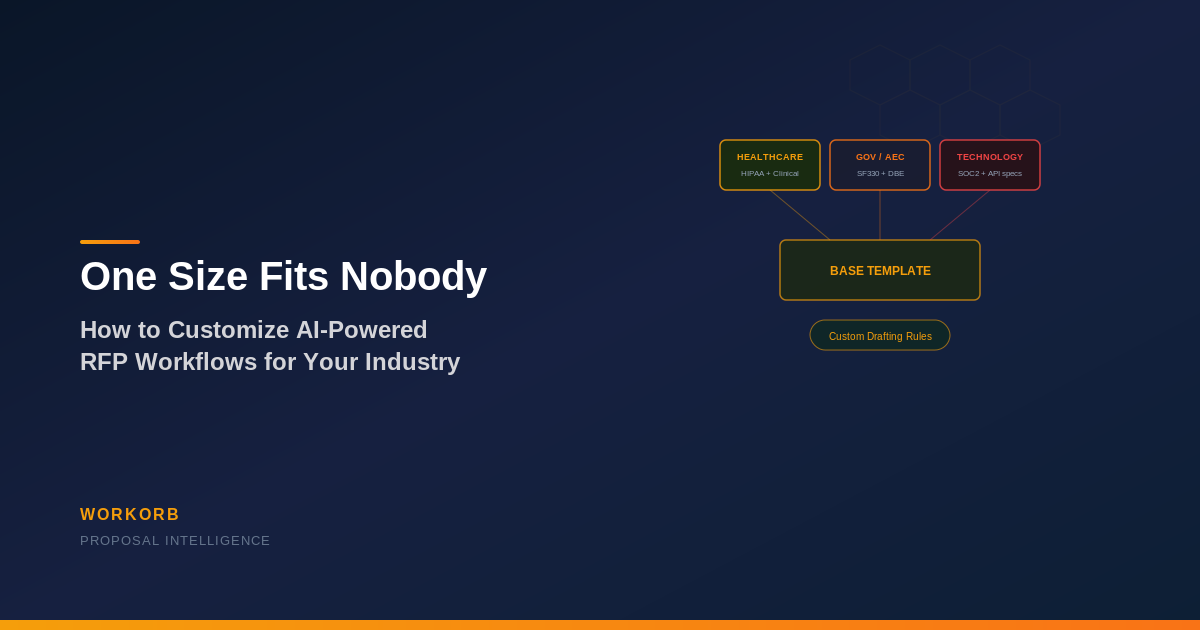
Layer 1: Industry-specific templates. Different industries evaluate proposals differently. Government evaluators expect structured compliance matrices and specific section ordering. Healthcare clients want clinical evidence and patient outcome data upfront. Technology buyers prioritize architecture diagrams and integration specifications. Workorb's template system supports distinct output formats for each industry vertical, so the proposal structure matches what evaluators in that sector expect to see.
Layer 2: Configurable output formats. Beyond templates, the actual artifacts produced need to adapt. Some clients want requirement matrices in spreadsheet format. Others want narrative compliance summaries. Some RFPs demand specific scoring rubrics. Workorb lets teams configure which outputs are generated for each pursuit: requirement matrices, scoring rubrics, timeline visualizations, compliance checklists, risk registers—each formatted to the client's specifications rather than a one-size-fits-all default.
Layer 3: Adjustable drafting rules. This is where customization gets genuinely powerful. A firm can define drafting rules that reflect their voice, positioning, and strategic priorities. 'Always lead with quantified outcomes.' 'Reference specific project names rather than generic experience.' 'Match the client's terminology rather than using our internal jargon.' 'For government bids, use formal third-person tone; for commercial bids, use direct second-person.' These rules shape every AI-generated draft, producing content that sounds like your firm wrote it—because your firm defined how it should sound.
Consider a professional services firm responding to the same client across three regions. The core offering is identical, but each region has different regulatory requirements, local compliance frameworks, and evaluation preferences. Without customization, the team either produces three identical proposals (ignoring regional differences) or manually rewrites each one (negating the efficiency gains of AI).
With Workorb's customization engine, the firm creates a base pursuit template, then applies regional overlays. The Northeast submission emphasizes local labor compliance and prevailing wage experience. The Southwest version highlights water conservation expertise and tribal consultation experience. The Midwest proposal leads with infrastructure rehabilitation and extreme weather design considerations. Same core solution, different positioning—all generated from the same content library with region-specific rules applied automatically.
This is what genuine customization looks like in practice. Not just swapping logos and headers, but adapting the substance, emphasis, and regulatory alignment of every section to match what evaluators in each context actually care about. Workorb makes this possible because customization is built into the platform's architecture, not added as an afterthought. Templates, output formats, and drafting rules are all configurable by pursuit, by client, by region, and by industry—so every proposal feels tailored because it is.


