
An architectural firm in the Northeast receives a 180-page municipal RFP for a new health sciences building at a state university. Buried in Section 3 is a detailed selection criteria matrix that weights relevant experience on academic healthcare projects at 35%, key personnel qualifications at 25%, and technical approach at 40%. Somewhere in Section 7 are DBE participation goals. The schedule milestones are scattered across two attachments. Insurance and bonding requirements appear three times in different formats.
For most AEC firms, this is the moment when business development teams begin the familiar ritual: manually highlighting, copying, pasting, and cross-referencing across proposal management tools. Weeks of effort disappear into document assembly. Critical requirements get missed. The technical narratives don’t align cleanly with evaluation criteria. And when a similar opportunity appears next month—a different client, same project type—the entire process repeats from scratch.
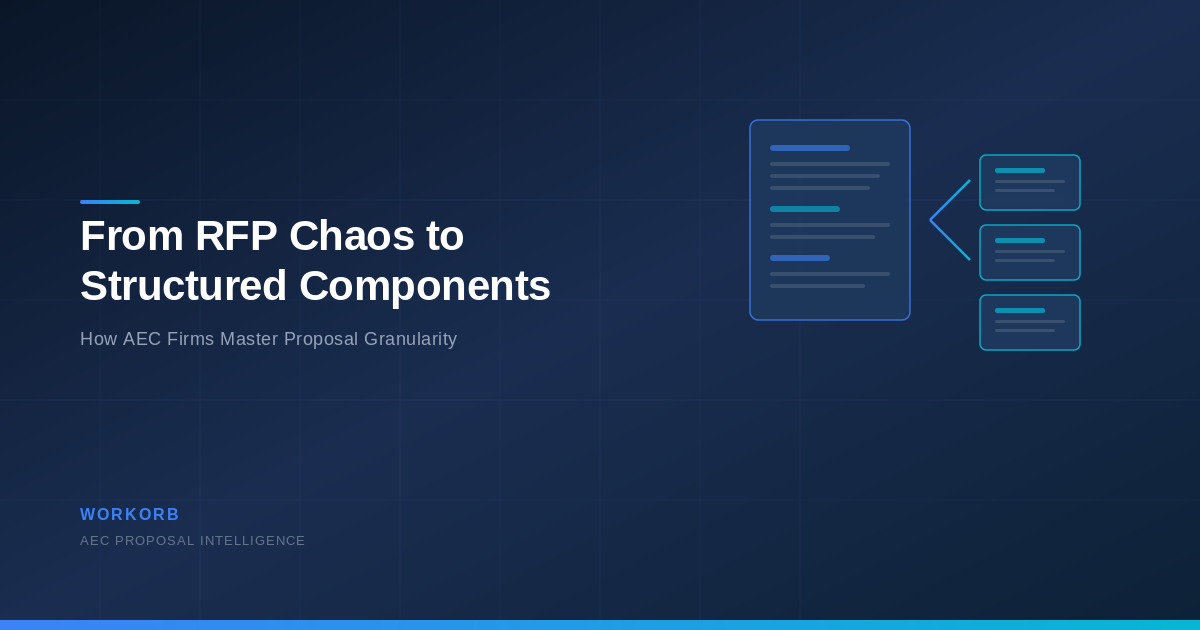
The most efficient AEC firms have moved beyond this chaos. They’ve learned to see RFPs not as monolithic documents but as collections of discrete, extractable components that can be structured, tagged, and reused across dozens of future pursuits. This is the power of proposal granularity—and it’s transforming how leading firms compete.

Learn how leading AEC firms extract and structure RFP requirements into reusable proposal components—from project sheets to compliance matrices—to dramatically accelerate pursuit cycles.
Granularity in AEC proposal management means breaking dense RFP documents into their constituent parts: selection criteria, project requirements, delivery expectations, compliance obligations, and resource constraints. Each component gets extracted, standardized, and tagged by project classification—transportation infrastructure, water/wastewater treatment, healthcare facilities, K-12 educational buildings, mixed-use development.
Consider the SF330 form, the standard qualifications statement required by most public sector clients. Rather than treating each SF330 as a one-off document, firms that embrace granularity recognize that SF330 sections—organizational capacity, past performance, key personnel, technical approach—are composed of repeatable building blocks. Past performance narratives describing a firm’s work on similar projects can be authored once, properly, and then indexed by project type, client category, budget range, and delivery method. When a new RFP arrives, the correct past performance narratives can be algorithmically matched to the client’s stated priorities and evaluation criteria.
The same principle applies to project sheets. An architecture firm that has documented its experience on 200 completed projects can structure that data to capture: project type (academic, healthcare, civic), size (square footage, budget), delivery method (design-bid-build, design-build, CM at-risk), timeline, client sector, key personnel involved, and relevant outcomes (LEED certification, schedule performance, value engineering achievements). This structured project inventory becomes searchable and matchable against new RFP requirements.
The real challenge in granularity isn’t organizing information that’s already well-presented. It’s systematically extracting requirements from the places where clients actually embed them: in narrative sections, appendices, compliance matrices, and regulatory references.
A transportation engineering firm pursuing a DOT infrastructure design project must extract not just the explicit scope (roadway reconstruction, bridge replacement, utility coordination) but also implicit requirements scattered throughout the RFP: prevailing wage compliance mandates, DBE/MBE/WBE participation goals (often tied to specific budget percentages), bonding requirements (performance bonds, payment bonds, sometimes bid bonds), insurance specifications (professional liability limits, general liability coverage), traffic management expectations during construction, and environmental permitting dependencies.
Efficient firms build processes—often augmented by intelligent tools—to systematically scan RFPs and extract these scattered requirements into standardized fields. For a 200-person engineering firm pursuing 15-20 opportunities per year, this extraction automation alone can reclaim hundreds of hours annually.
Once requirements are extracted and standardized, they populate a structured library of proposal components. For AEC firms, this library typically includes project sheets with standardized fields capturing relevant past experience, personnel resumes and CVs formatted consistently and tagged by discipline and role, past performance narratives indexed by project type and client category, technical approach templates customized by delivery method, compliance matrices pre-populated with firm capabilities and certifications, and subconsultant information standardized and maintained centrally.
Consider a mid-size architecture practice that specializes in healthcare facilities. Their library contains 40 completed healthcare projects. For a new RFP from a health system, instead of manually compiling a past performance section, the firm’s proposal system can automatically surface the 8-10 most relevant projects—filtered by facility type, size range, and whether they achieved the LEED/sustainability outcomes the new client is seeking.
The same applies to key personnel. An engineering firm pursuing an environmental remediation project can quickly assemble a qualified team by searching their personnel database for individuals with soil science backgrounds, EPA compliance experience, and specific project management credentials. Their resumes are already in standardized format, making document assembly trivial.
The secret to making granular components truly reusable is rigorous tagging and classification. Every past performance narrative, project sheet, and personnel resource gets indexed not just by project name but by multiple dimensions: project type (horizontal infrastructure, vertical construction, environmental services), delivery method (design-bid-build, progressive design-build, CMAR), client sector (public transportation, municipal water, K-12 education, higher education, healthcare), geographic region, team size, and relevant outcomes.
This multi-dimensional indexing allows proposal managers to run intelligent queries. A design-build firm pursuing a complex infrastructure project can search for past design-build projects with DOT clients including subconsultant coordination to find exactly the right examples demonstrating capability across their entire team network.
For firms managing multiple AEC disciplines—architecture, structural engineering, MEP, cost estimating—this tagging becomes essential. The same project might be relevant to multiple RFPs but for different reasons. Proper tagging ensures nothing gets buried in the firm’s institutional knowledge and every pursuit benefits from the full breadth of firm experience.
For AEC firms competing in municipal, state, and federal procurement environments, granularity creates three compounding advantages. First, it collapses cycle time. A firm that can extract RFP requirements in hours rather than days, match those requirements to an indexed library of components in minutes rather than hours, and assemble a proposal-ready draft in days rather than weeks gains enormous competitive advantage.
Second, it ensures consistency and quality. When every technical narrative is authored with full awareness of evaluation criteria, when every past performance example directly addresses the client’s stated priorities, and when every team member’s credentials are properly matched to role requirements, the proposal becomes more persuasive.
Third, it creates learning feedback loops. After a proposal is submitted, AEC firms can analyze win/loss outcomes—which past performance narratives were most persuasive, which team compositions resonated with clients, which technical approaches aligned with winning proposals. This feedback refines the component library continuously. The future of AEC proposal management belongs to firms that treat their collective experience as structured, searchable, reusable assets rather than unorganized institutional knowledge.


