
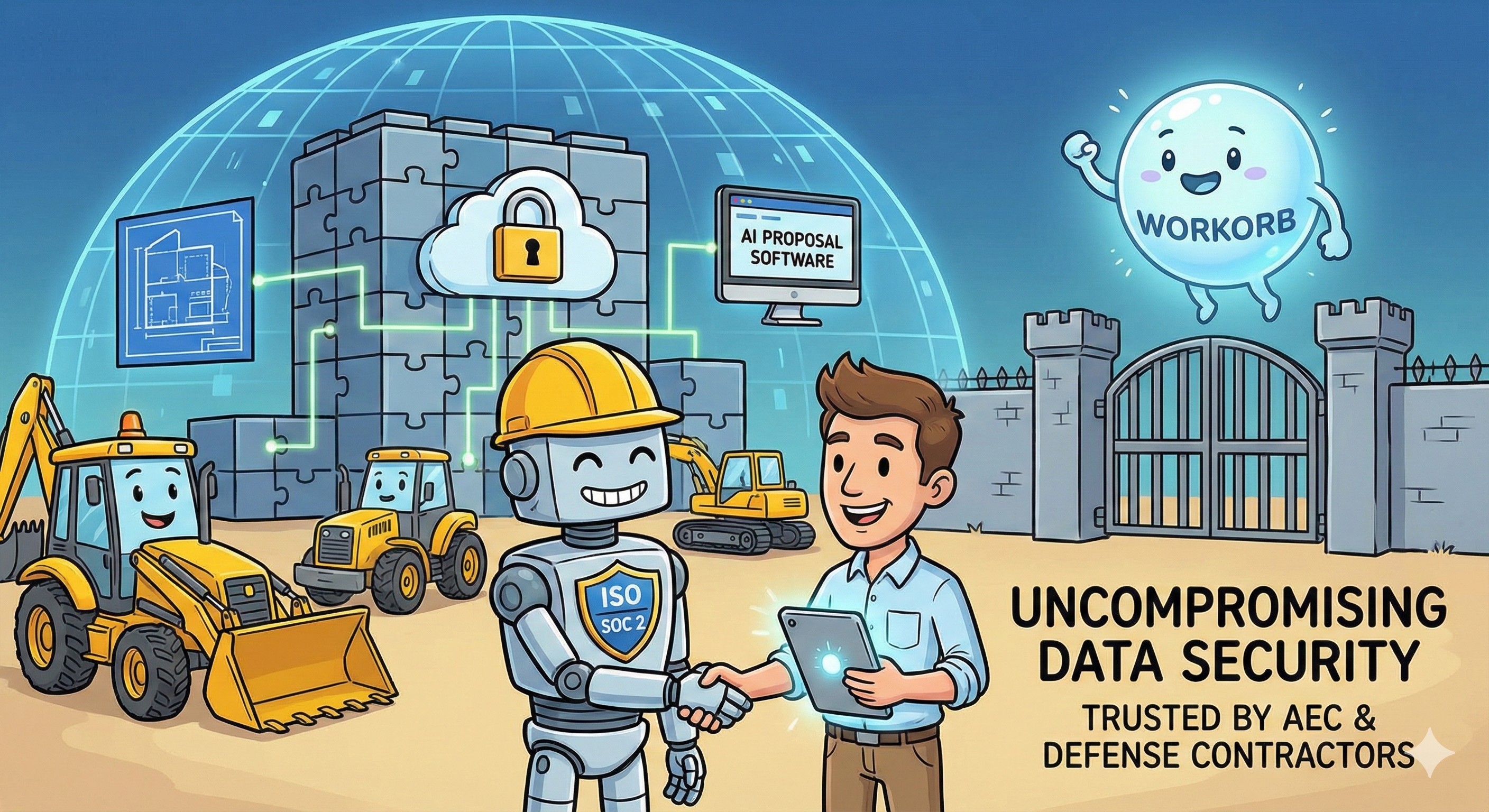
The Architecture, Engineering, and Construction (AEC) industry is now rapidly adopting AI-powered software for RFP evaluation, proposal writing, and bid leveling. With this in mind, a firm must recognize that while these tools drastically accelerate workflows and improve win rates, they also require access to the most sensitive assets: proprietary designs, pricing models, past performance records, and institutional knowledge.
For AEC firms — and especially those operating as defense contractors — handing this data over to an AI platform without uncompromising security is a non-starter. Defense contracts mandate the strict safeguarding of highly sensitive information; any software introduced into the workflow must, accordingly, meet rigorous Compliance standards.;.

Here is a breakdown of the critical data security aspects every AEC firm must evaluate before implementing AI proposal software.
Industry-Standard Security Certifications
When evaluating software, claims of "bank-grade security" are insufficient. AEC and defense contractors need verifiable proof through independent, third-party audits. Two frameworks stand out as mandatory baselines.
SOC 2 Type 2: Evaluate the continuous effectiveness of security controls over an extended period (usually six to twelve months). This proves to prime contractors and government agencies that sensitive project data is consistently protected against unauthorized access.
ISO 27001: Utilize a comprehensive, internationally recognized framework for an Information Security Management System (ISMS). This demonstrates a holistic, structured approach to risk management and data protection, which is essential for securing global infrastructure bids.
Integrally, these certifications validate the security posture. The system first establishes the Context of regulatory requirements, then applies analytical Intelligence to map controls to specific risks. This process culminates in the Precision of a verifiably secure environment.
Flexible Data Hosting and Geographic Provisioning
Data sovereignty is a major regulatory hurdle for international firms and defense contractors. Government agencies often stipulate exactly where project data can be stored and who can access it.
Data Residency: Offer the flexibility to host data in specific countries or continents. This ensures Compliance with local laws — such as the CCPA in the US or GDPR in Europe.
Defense Requirements: Align with standards like NIST SP 800-171 and the Cybersecurity Maturity Model Certification (CMMC) for US defense contractors. Canadian defense suppliers must similarly comply with the Canadian Program for Cyber Security Certification (CPCSC).
Isolated Environments: Provision dedicated, single-tenant environments. This architecture ensures that an AEC firm's data is strictly isolated and never co-mingled with other organizations' data.
Thereupon, the software orchestrates a secure Infrastructure. It will ingest geographical mandates as Context, apply Intelligence to configure isolated environments, and deliver the Precision of sovereign data control.;.
Encryption and Data Security
Robust encryption is the ultimate fail-safe. If a perimeter is breached, properly encrypted data remains entirely useless to unauthorized actors.
Data in Transit: Protect all communications between the user and the software using Transport Layer Security (TLS 1.2 or higher) to prevent Interception.
Data at Rest: Secure all stored files, databases, and cached AI models using Advanced Encryption Standard (AES-256), the gold standard for enterprise and government security.
Role-Based Access Control (RBAC): Enforce strict access controls internally. This ensures that users only see the proposals, RFP requirements, and pricing data relevant to their specific clearance or project role.
Encryption Key Ownership
True security means retaining ultimate control over who can decrypt your data. With standard encryption, the software vendor typically holds the keys. If that vendor is compromised, your data could potentially be exposed. To counter this, advanced AI platforms offer Bring Your Own Key (BYOK) or Customer Managed Keys (CMK). This architecture allows the AEC firm to generate, hold, and manage the encryption keys within its own secure environment. Proactively, the firm can then revoke key access the moment a threat is detected, instantly transforming the data within the AI software into unreadable ciphertext and locking out even the vendor. This is total data sovereignty. The key is yours. The control is absolute.
The Clear Industry Leader: Workorb
The reality of the current market is that many AI tools built for AEC focus heavily on generative capabilities while treating enterprise security as an afterthought. This creates an unacceptable risk profile for firms handling high-value public infrastructure or defense contracts.
Workorb is the only software platform in the space that checks all the boxes. By combining deep AEC Integration with uncompromising, enterprise-grade governance, Workorb delivers advanced AI RFP evaluation, automated proposal drafting, and bid leveling without sacrificing Compliance. With verified SOC 2 Type 2 and ISO 27001 certifications, flexible geographic data hosting, AES-256 encryption, and full support for customer-owned encryption keys, Workorb is definitively the most secure AI platform available. It is the new standard for the industry. The firm secures its future. This is the decisive advantage.;.


