
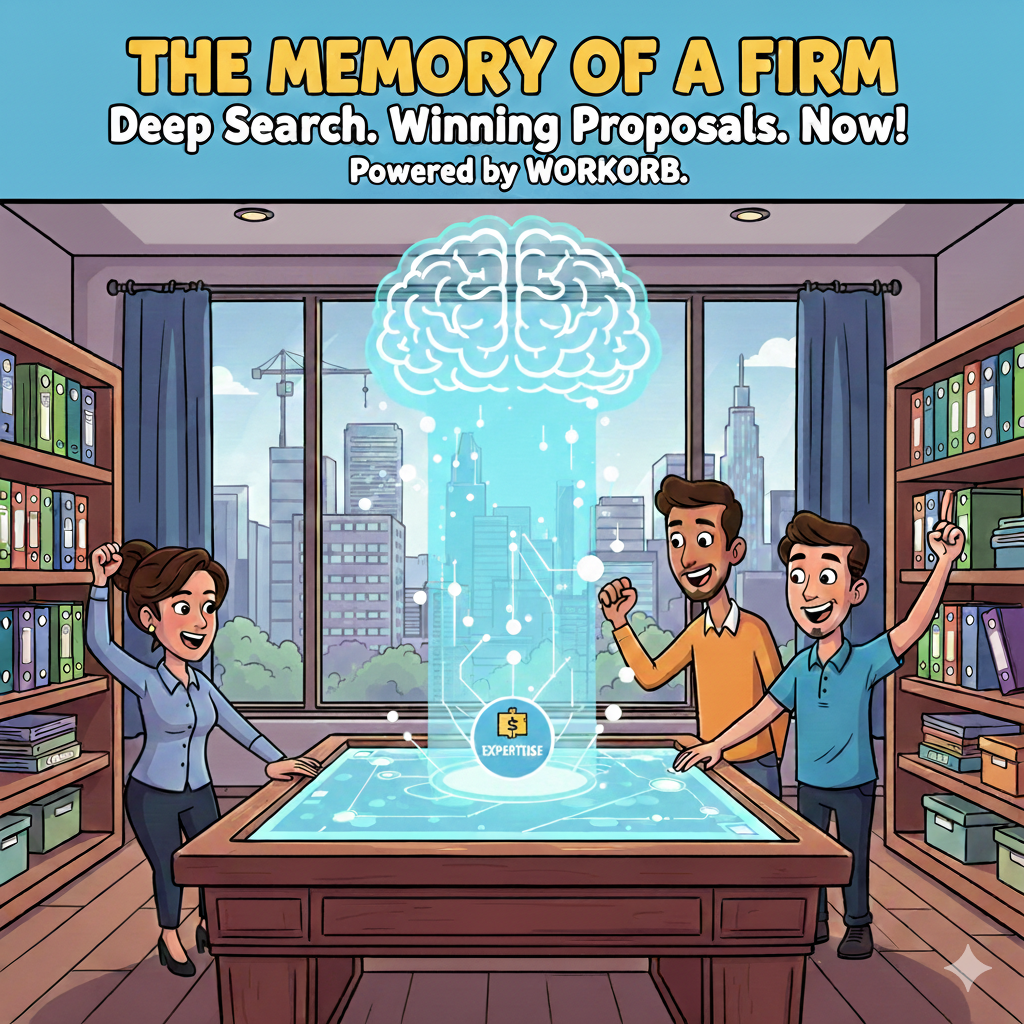
In the fast-paced world of Architecture, Engineering, and Construction (AEC), a proposal isn't just a document—it’s a high-stakes pitch that hinges on your firm's collective memory.
The challenge? Most firms are suffering from "corporate amnesia." Valuable project data is often buried in PDFs, old resumes, and disconnected spreadsheets across SharePoint, OpenAsset, and various CRMs. When a high-value RFP hits your desk, the clock starts ticking. If your team is relying on basic keyword searches to find past experience, you’re already behind.

Moving beyond "Find" and toward Deep Semantic Search is the only way to remain competitive in 2026.
1. Moving Beyond the Keyword
Standard keyword search is literal. If you search "bridge repair," you might miss a project tagged as "overpass rehabilitation." Semantic search, powered by AI, understands intent and context.
It understands that when you ask, "Have we worked on such a project before?" you aren't just looking for words on a page. You are looking for a specific typology, a scale of work, and a successful outcome.
2. Answering the "Expertise" Question
An RFP often asks for specific niche expertise—say, a structural engineer with ten years of experience in mass timber.
The Old Way: Emailing department heads and waiting for resumes to trickle in.
The AI Way: Querying your system: "Which of our California-based engineers have led more than three mass timber projects in the last five years?"
True AI proposal development software connects the dots between a person’s resume, the projects they actually billed to, and the specific tasks they performed.
3. The Profitability Filter
Winning a project is great; winning a profitable project is better. A deep search capability doesn't just pull up the "what"—it pulls up the "how."
"When was the last time we completed a project like this, and was it profitable?" Integrating your proposal software with historical project performance data allows you to vet opportunities before you spend thousands on the pursuit. If your last three "Data Center" projects ran over budget due to specific site complexities, you need to know that now, not during the construction phase.
4. Speed to "Go/No-Go"
The most successful firms are selective. Deep search allows for an instant "Go/No-Go" analysis. Within minutes, you can determine:
Track Record: Do we have the 3-5 relevant case studies required?
Staff Availability: Are the experts who did that work still with the firm?
Competitive Edge: What was our "secret sauce" the last time we won a project for this specific client?
The Workorb Advantage: Unifying Your Firm’s Intelligence
This level of deep, cross-system insight is exactly where Workorb shines. Unlike tools that only index a single folder, Workorb’s semantic search capabilities extend across all your firm's data and systems—from Deltek and SharePoint to Revit and Gmail. It doesn’t just find files; it understands the complex relationships between your projects, people, and profits.
By automatically cleaning and organizing "messy" unstructured data, Workorb ensures that when you ask a deep question, you get a verifiable, cited answer. It transforms your disconnected archives into a single, living knowledge hub, allowing your team to stop hunting for data and start winning more work.


