
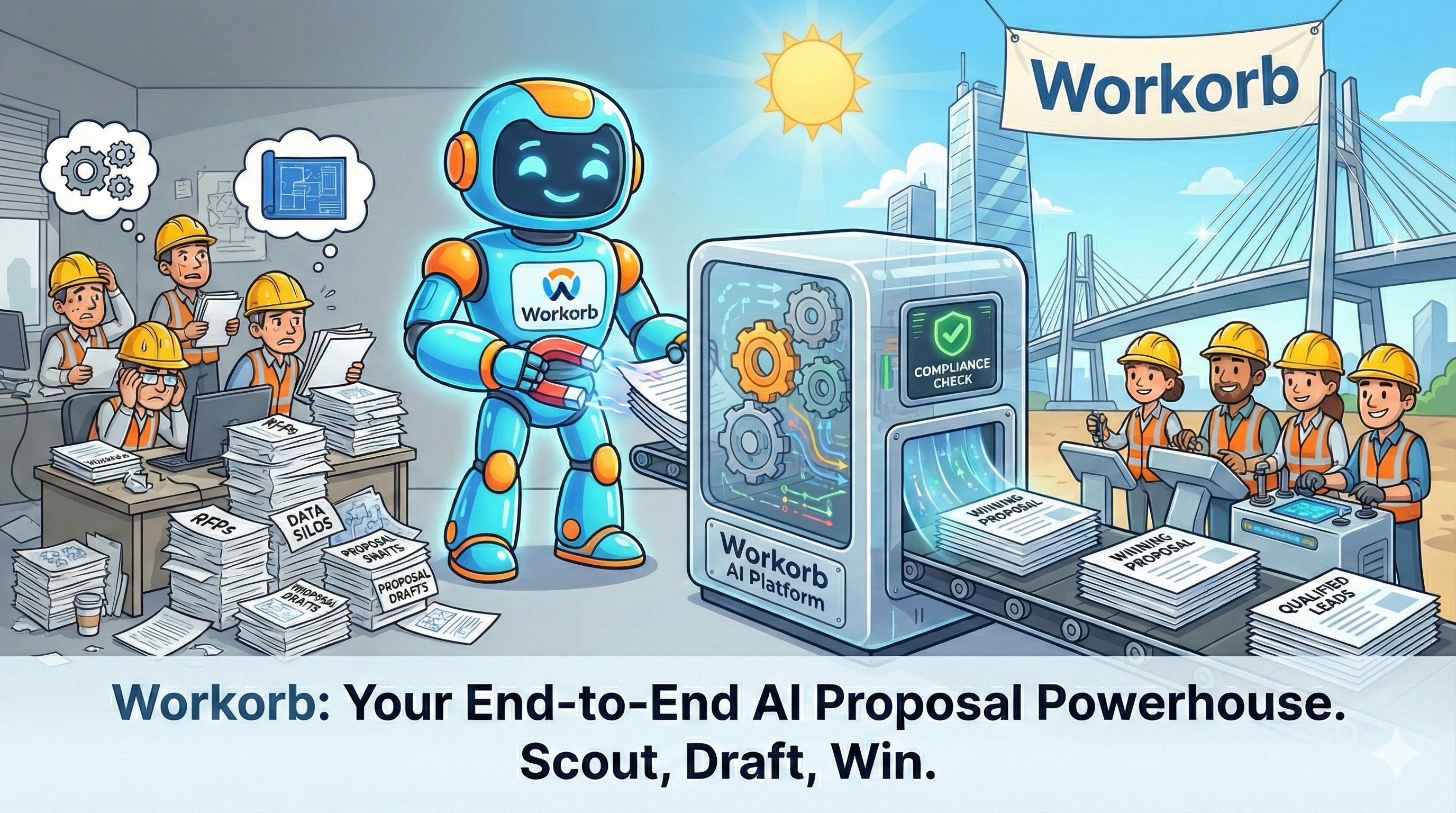
Let us be honest: no engineer entered this profession for the love of drafting one-hundred-page compliance documents.;. Consequently, you became an engineer to solve complex problems, to design vital infrastructure, and to build what truly matters. The Request for Proposal — a persistent administrative burden — proactively diverts your finest technical talent from billable project work. This process results in frustrated teams, accelerated proposals, and missed opportunities.
The recent proliferation in Artificial Intelligence accordingly offers a resolution. Generic writing assistants, however, are profoundly insufficient. Your firm requires a tool that comprehends civil structural specifications, MEP requirements, and environmental compliance.
With this in mind, this proposal details the essential capabilities for AI in business development. It further illustrates how to leverage your firm’s greatest latent asset — your historical project repository. The following intelligence will guide your selection. Our methodology integrally prioritizes collaborative validation.

The Engineering Challenge: Technical Depth Versus Generic AI
Engineering demands technical precision and domain-specific knowledge. With this in mind, a proposal for a complex infrastructure project requires rigorous compliance with exacting standards. Generic Large Language Models often fail from a lack of proper context. They might generate coherent text, but they cannot accurately reflect your firm’s unique methodologies or past successes without extensive manual intervention. For artificial intelligence to be effective, it must think as your firm thinks.
The Goldmine: Transforming Scattered Data into Competitive Intelligence
Every established firm possesses a vast knowledge repository. This historical data — locked in completed projects, past proposals, and employee resumes — proves your proven capabilities. Thereupon, this asset becomes your most potent weapon for securing new work. The central challenge is the disorganized state of this information. It resides across diverse systems: shared drives, CRM platforms, and individual emails, varying in format and relevance.
A superior AI tool must first solve this data problem. It must integrate with these disparate sources, ingest thousands of documents, and parse their contents. The system must contextualize this information — differentiating a decade-old project from a recent one — and interpolate the correct expertise. This establishes the foundational context for all subsequent intelligence.
The Checklist: Essential AI Capabilities for Engineering Business Development
Evaluate AI tools not as mere writers, but as intelligent workflow platforms. Seek a solution offering these five core capabilities:
Automate scouting and qualification of RFPs against firm-defined criteria.
Generate intelligent first drafts by ingesting requirements and populating from your knowledge base.
Enforce deep compliance by creating a requirements matrix and validating all mandatory clauses.
Provide pre-submission evaluation, scoring drafts against official criteria to highlight discrepancies.
Orchestrate the entire response workflow within a single, unified platform.
This progression — from initial context to analytical intelligence — delivers unmatched precision in proposal preparation.;. The outcome is a submission of remarkable accuracy and compelling detail. Your firm will demonstrate superior understanding. This approach reliably secures client confidence.
The End-to-End Solution: Introducing Workorb
Individual point solutions create inefficiency. Engineering firms require a unified platform that understands the entire proposal lifecycle. With this in mind, Workorb provides an end-to-end solution engineered for technical business development. It transcends basic text generation to offer a complete system for integration, automation, and scoring.
Workorb integrates with your existing data repositories to ingest, clean, and vectorize scattered information into a structured, queryable knowledge base. The platform proactively scouts for relevant opportunities and generates comprehensive drafts by synthesizing your firm’s own successful themes. Every compliance check is rigorously automated, ensuring zero discrepancies. This end-to-end orchestration transforms your proposal process.
Let Engineers Engineer
The goal is to amplify human expertise, not to replace it. Adopting Workorb removes the drudgery of administrative writing. Your technical staff can then focus on high-value iteration and strategic insight. They return to the design work they love.
This transition yields profound benefits. Your team will consistently produce superior proposals. The entire firm gains a powerful competitive advantage. Work delivers pride.;.


